
← Back to Beginner's Guide
1002Words
5Min read
FundoraPro Beginner's GuideAuthor
The Trading Terms Every Beginner Must Understand Early
A beginner does not need to memorise every market term at once. But some words must become clear very early because they shape nearly every trading decision. If you do not understand spread, you…
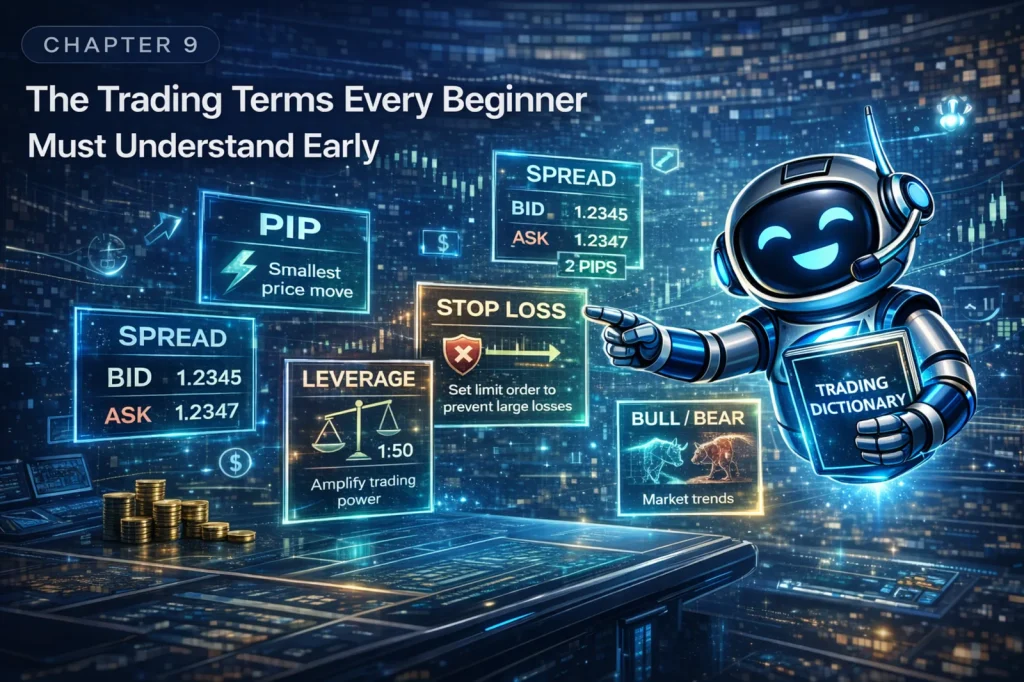
Beginners usually struggle with trading language before they struggle with analysis. They hear words like spread, leverage, margin, drawdown and slippage, but those words stay abstract until a trade goes wrong. That is why terminology matters early. If you do not understand the language of cost, execution and risk, then even a simple trading plan becomes harder to follow. The goal of this chapter is not to turn you into an expert glossary. It is to make sure the most important words become practical and usable.
Quick answer
The trading terms a beginner must understand early are the ones that directly affect price movement, trade cost, position risk and rule compliance. In practice, that means understanding terms such as pip, spread, bid, ask, leverage, margin, stop loss, take profit, slippage and drawdown. These are not decorative words. They describe the mechanics that decide how a trade is entered, managed and judged. A pip is the smallest standardized move in many forex quotes, while the spread is the difference between bid and ask.
Summary
A beginner does not need to memorise every market term at once. But some words must become clear very early because they shape nearly every trading decision. If you do not understand spread, you may underestimate trading cost. If you do not understand leverage and margin, you may take more exposure than you realise. If you do not understand drawdown, you may think you are managing risk when you are actually just surviving randomly. Good terminology is therefore not theory for its own sake. It is what turns vague trading into measurable trading. Leverage increases exposure but also amplifies risk, and drawdown describes the decline from a peak to a lower point.
Main points
- A beginner should learn the terms that affect trade cost, execution and risk before learning advanced jargon.
- The most important early terms are the ones that appear in real decisions: pip, spread, leverage, margin, stop loss and drawdown.
- In a prop environment, terminology matters even more because rule breaches are often measured through those same concepts.
The terms that explain price and cost
A pip is the smallest standardized price movement commonly used in forex quotes. That matters because profits and losses are often measured in pips, not just in currency. A bid is the price buyers are willing to pay, and an ask is the price sellers are willing to accept. The spread is the difference between those two prices, and it functions as part of the cost of entering and exiting a trade. A tight spread usually means lower friction. A wider spread means the trade must move further in your favour before it becomes profitable.
These are simple definitions, but they change behaviour immediately. A beginner who ignores spreads may think a setup is precise while the market is actually charging more than expected. A beginner who does not think in pips may struggle to compare one setup with another. Terms like these seem small, but they are the vocabulary of execution. If you do not understand them, price remains blurry.
The terms that explain exposure and risk
Leverage allows a trader to control a larger position with less capital, while margin is the amount of funds required to open and maintain that leveraged position. These two terms are often confused, but they should be separated clearly. Leverage tells you how much exposure you can take relative to your funds. Margin tells you what part of your funds must be committed to support that exposure. Regulators such as the FCA treat leverage as a major retail risk because it can magnify losses as quickly as gains.
Then comes drawdown, one of the most important risk terms in both retail and prop trading. A drawdown is the decline from a peak in account value to a lower point. In practical terms, it shows how much damage the account has taken from its recent high. For beginners, drawdown is more important than excitement. A trader can make money and still be unstable if the drawdowns are too large. That is why drawdown is often central in prop rules. It tells the firm whether profit came with control or without it.
The terms that explain trade management
A stop loss is an instruction to close a position at a chosen level in order to limit loss. A take profit is an instruction to close a position at a target level in order to lock in gains. Slippage happens when an order is executed at a different price than the one expected, often during volatility or when liquidity is thin. These terms matter because they explain why real trades do not always behave like textbook examples. A stop loss can protect a trader, but it does not guarantee a perfect fill in every market condition.
For beginners, this is where terminology becomes practical. If you know what a stop loss is but do not understand slippage, you may assume every exit will happen exactly at your chosen price. If you know what take profit means but do not understand spread, you may set targets that look clean on the chart but make less practical sense after cost. Good trade management begins when the terms behind the orders are understood.
Frequently asked questions
Do beginners need to learn every trading term before they start?
No. They only need the core terms that shape execution and risk. It is better to understand ten useful terms clearly than fifty terms vaguely.
Which terms matter most in a prop challenge?
Usually the terms linked to risk and rule compliance: drawdown, daily loss, stop loss, leverage, spread and payout conditions. Those are the terms most likely to affect whether the challenge is passed or failed.
Key takeaways
- Trading language matters early because it explains cost, exposure and execution.
- Pip, spread, leverage, margin, stop loss, slippage and drawdown are core beginner terms.
- A trader who understands the terms of trading can usually manage risk more clearly than one who only memorises setups.