
← Back to Beginner's Guide
866Words
4Min read
FundoraPro Beginner's GuideAuthor
Prop Firm vs Broker: Which Model Makes More Sense for a Beginner?
The broker model and the prop model solve different problems. A broker gives direct ownership over the trading account and complete freedom, but it also means every mistake comes directly out of personal capital.…
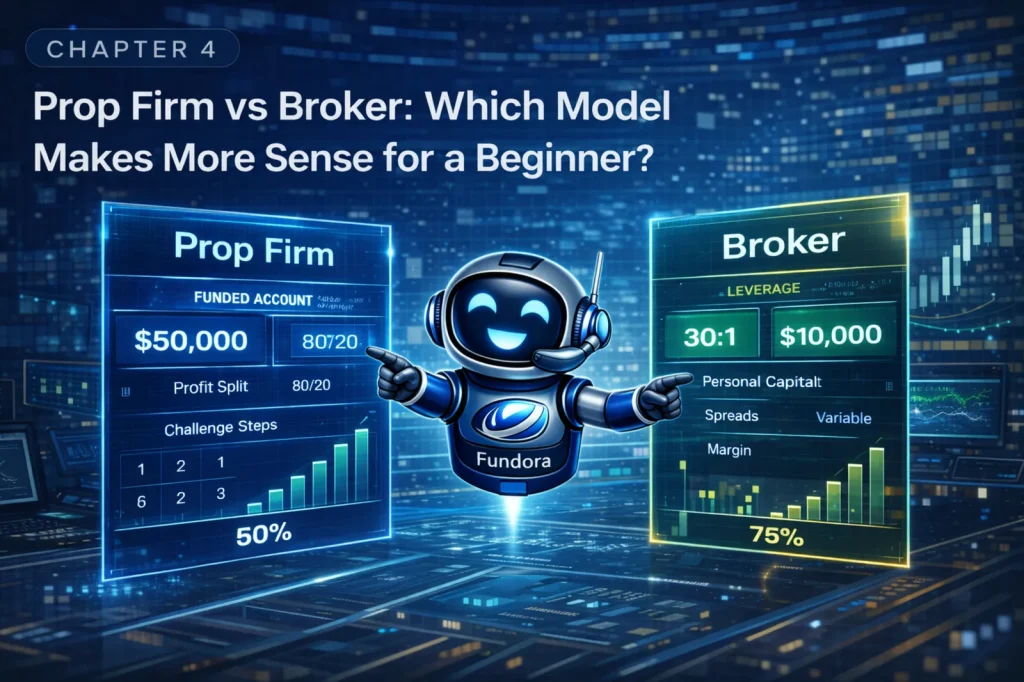
Beginners often compare prop firms and brokers as if both were simply two different places to place trades. That misses the real difference. A broker gives you a personal account funded with your own money. A prop firm gives you a rules-based evaluation path in which you pay an entry fee and trade inside fixed limits. The real beginner decision is not just where to click buy or sell. It is whether you currently need freedom or structure.
Quick answer
A broker makes more sense for a beginner who wants full control over their own capital, accepts full responsibility for losses and prefers to trade without an external rulebook. A prop firm makes more sense for a beginner who wants a structured environment, defined risk limits and a chance to access a larger account model without depositing large personal capital. The better choice depends less on hype and more on whether the trader currently benefits more from flexibility or discipline.
Summary
The broker model and the prop model solve different problems. A broker gives direct ownership over the trading account and complete freedom, but it also means every mistake comes directly out of personal capital. A prop firm reduces the need for a large deposit, yet replaces that freedom with evaluation rules, drawdown limits and payout conditions. For beginners, the better model is often the one that best matches their current weakness. Traders who need stronger discipline often benefit from a prop structure. Traders who already have a stable process and want total independence may prefer a broker account.
Main points
- A broker account offers freedom, but all profits and losses come directly from your own deposit.
- A prop firm offers structure and reduced direct capital exposure, but requires rule compliance.
- Beginners should choose based on what helps them trade better, not on which model sounds more exciting.
What a broker actually gives you
A broker account gives you direct control over your own trading capital. You decide position size, trading style, timing and risk without needing to pass an evaluation first. That flexibility can be valuable, especially for traders who already understand their method and want full independence. But for a beginner, that same flexibility can also become a problem. Without clear limits, it is easy to increase risk after losses, overtrade during emotional sessions or ignore basic discipline because nothing in the structure forces restraint.
This is why a broker account is not automatically the “simpler” option. It is operationally simple, but behaviourally demanding. The trader must create and respect their own rules every day. A beginner who cannot yet do that consistently may find that freedom becomes expensive very quickly.
What a prop firm actually gives you
A prop firm changes the structure. Instead of trading only your own deposited capital, you enter an evaluation path with defined rules. That usually means profit targets, drawdown limits and payout conditions. The advantage is that the trader can work toward a larger account model while risking a fixed challenge fee rather than funding the entire account personally. For many beginners, that makes the path financially more manageable.
The trade-off is that the rulebook becomes part of the challenge. You are no longer free to improvise without consequences. That can feel restrictive, but it also creates a framework that exposes bad habits faster. A beginner who benefits from visible boundaries, a dashboard-based workflow and a structured progression from challenge to funded conditions may perform better in this environment than in a completely open personal account.
Which model makes more sense at the beginner stage
The best beginner choice depends on what kind of problem the trader is trying to solve. If the main issue is lack of discipline, weak risk control or emotional inconsistency, a prop firm often makes more sense because it imposes limits that the trader may not yet impose on themselves. If the trader already has strong self-control, prefers independence and wants full ownership over every trading decision, a broker account may be the cleaner long-term model.
The mistake beginners make is assuming one model is universally better. That is not true. A broker is better for independence. A prop firm is better for structured measurement. The useful question is not which model is more popular. It is which one makes you more likely to survive the learning phase without destroying either your capital or your discipline.
Frequently asked questions
Is a prop firm safer than a broker for a beginner?
It can reduce direct personal capital exposure because the trader usually pays a fixed fee instead of funding a large account. But it also introduces rules that must be respected, so it is safer in one sense and stricter in another.
Do serious traders eventually leave prop firms for brokers?
Not always. Some traders prefer the independence of brokers, while others continue using prop structures because they value the framework, account access and payout model.
Key takeaways
- Brokers offer freedom and full ownership, but also full personal risk.
- Prop firms offer structure and lower direct capital exposure, but require discipline inside a rulebook.
- The better beginner choice is the one that improves behaviour, not simply the one with the bigger headline promise.