
← Back to Beginner's Guide
859Words
4Min read
FundoraPro Beginner's GuideAuthor
Trading Psychology for Beginners: The Mental Mistakes That Damage Good Plans
The beginner mistake is not having emotions. That is impossible. The real mistake is letting emotions become the decision-maker. Fear can cause premature exits. Greed can cause oversized trades. Frustration can lead to revenge…
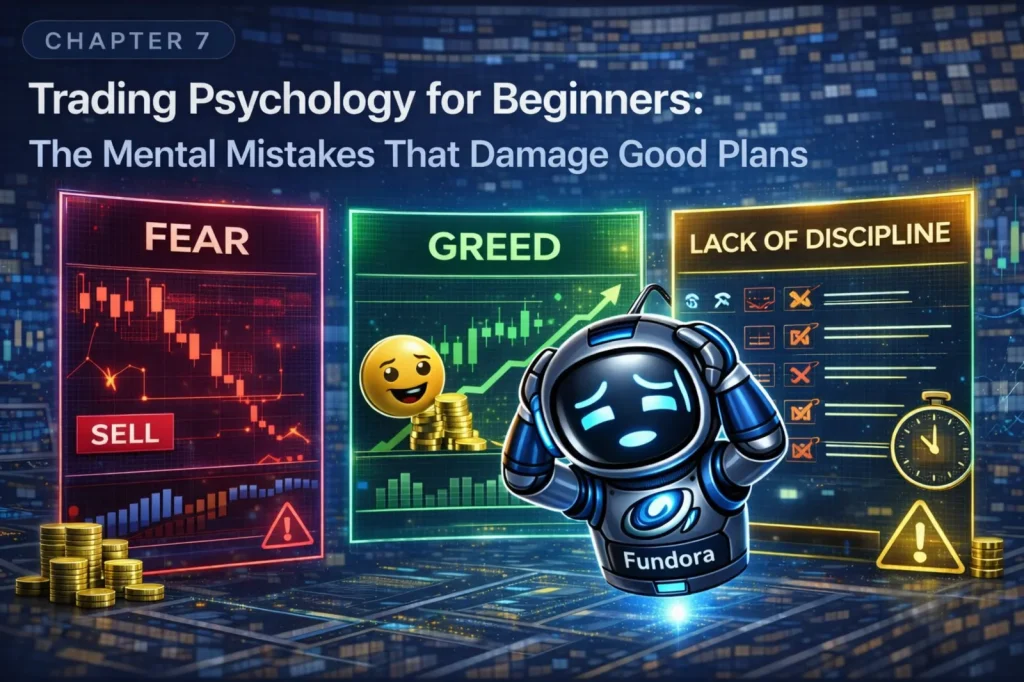
Most beginners think psychology becomes important only after they already know how to trade. In reality, it matters much earlier. A trader can understand charts, entries and risk rules on paper and still fail because the decision-making process breaks down under pressure. That is why trading psychology should not be treated as a soft extra. It is part of execution. If strategy tells you what to do, psychology determines whether you can still do it when money, time pressure and frustration enter the picture.
Quick answer
Trading psychology is the part of trading that deals with emotion, bias, discipline and self-control. For a beginner, it matters because good decisions are not made only by knowing the rules. They are made by staying calm enough to follow them. A trader with a simple strategy and strong discipline will usually perform better than a trader with a complex strategy and weak emotional control.
Summary
The beginner mistake is not having emotions. That is impossible. The real mistake is letting emotions become the decision-maker. Fear can cause premature exits. Greed can cause oversized trades. Frustration can lead to revenge trading. Overconfidence can make one good trade feel like proof that the rules no longer matter. Good trading psychology does not remove emotion. It puts structure around it. That usually means clear risk limits, fewer impulsive decisions and a repeatable routine before, during and after each trade. FundedNext explains this chapter in very similar terms by focusing on emotions, bias, mental discipline, journaling and risk planning rather than on “confidence” alone.
Main points
- Psychology affects execution because emotion can override strategy in real time.
- Beginners need routines and risk limits so that feelings do not become trade signals.
- Discipline is not about perfection; it is about returning to a logical process quickly.
Why emotion changes trading decisions so fast
The market creates emotional pressure because every open trade contains uncertainty. A beginner may know where the stop-loss should be, but once price starts moving against them, the trade no longer feels theoretical. It feels personal. That is when many bad decisions appear. Stops get widened, exits get rushed, and a normal loss suddenly feels like something that must be “won back” immediately.
This is why psychology matters even when the system itself is simple. Most trading mistakes are not caused by total ignorance. They are caused by stress changing behaviour. A beginner who understands this early gains an advantage. They stop asking only, “What is my setup?” and start asking, “What am I likely to do if this trade goes wrong?” That second question is often more important.
The main beginner problems: fear, greed and tilt
Fear usually appears after losses or during fast price movement. It can make traders hesitate, skip valid entries or exit good trades too early. Greed often appears after a few wins or during a strong move that makes the trader want more than the plan allows. Tilt appears when emotion takes control completely and the trader starts reacting instead of following process. FundedNext highlights this same issue by describing how emotion and bias can push traders away from logic and into impulsive behaviour.
A beginner should not try to become emotionless. That goal is unrealistic. The better goal is recognition. You need to know when you are no longer making decisions from structure. If a trade is being managed differently because you feel angry, rushed or desperate, then psychology has already taken over. At that point, the best move is often not a better entry. It is a pause.
How beginners build trading discipline in practice
Discipline becomes real when it is attached to behaviour, not to motivation. Saying “I will stay calm” is weak. Having a maximum number of trades per session, fixed risk per trade and a rule to stop after a loss streak is much stronger. Those tools do not make emotion disappear, but they limit the damage emotion can do.
A good beginner process is simple. Before the session, know what market you are watching and what kind of setup counts. During the session, risk the same amount each time and avoid changing the plan mid-trade. After the session, review whether you followed the process, not only whether you made money. That last part is important. If you judge every day only by profit, then emotion grows stronger. If you judge it by rule-following, discipline improves faster.
Frequently asked questions
Can beginners succeed without mastering psychology first?
They can begin learning without mastering it, but they usually cannot stay consistent for long if emotions keep overriding the plan. Psychology is part of the learning process, not something saved for later.
What is the fastest way to improve trading psychology?
Usually by reducing decision pressure: smaller risk, fewer trades, a written routine and honest post-trade review. Discipline improves faster when the process is simple enough to repeat.
Key takeaways
- Trading psychology matters because knowing the rules is not the same as following them under pressure.
- Fear, greed and tilt are normal, but they must not become the basis of decisions.
- Beginners improve faster when discipline is built through fixed routines, not through motivation alone.