
← Back to Beginner's Guide
919Words
5Min read
FundoraPro Beginner's GuideAuthor
Choosing a Prop Challenge
A challenge should be understood as a test structure, not as a shortcut to funded status. Different models create different decision-making environments. A two-step challenge usually spreads pressure over a longer process and can…
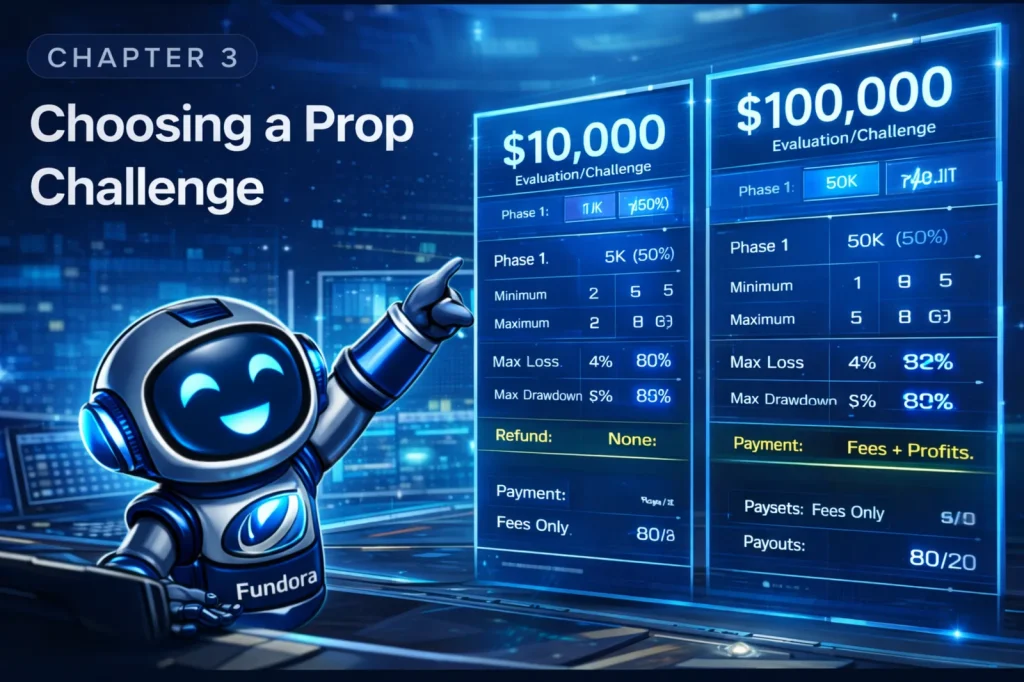
Beginners often choose a prop challenge the same way they choose a product online: they look for the fastest result, the biggest account or the offer that sounds easiest at first glance. That usually creates problems later. A prop challenge is not just a package size. It is a rule structure with a specific kind of pressure built into it. The right beginner question is therefore not, “Which challenge sounds most exciting?” but “Which challenge structure gives me the clearest chance to trade in control?”
Quick answer
The best prop challenge for a beginner is the one whose rules match the trader’s current level of discipline, risk control and consistency. A beginner should compare challenge models by looking at the number of steps, the profit target, the daily loss limit, the overall drawdown and the psychological pressure created by the format. A good beginner challenge is not necessarily the fastest one. It is the one that makes disciplined execution most realistic.
Summary
A challenge should be understood as a test structure, not as a shortcut to funded status. Different models create different decision-making environments. A two-step challenge usually spreads pressure over a longer process and can reward patience. A one-step challenge can feel more direct, but it often gives the trader less room for inconsistency. Instant funding may sound attractive because it removes the evaluation stage, yet it still requires strong rule awareness and emotional control. For beginners, the best challenge is usually the one they can explain clearly before they buy it and trade calmly after they start it.
Main points
- Different challenge types test different forms of discipline and emotional control.
- Beginners should compare the full rule structure, not just the speed of the funding path.
- The right choice is the challenge that makes controlled trading more likely, not the one that promises the fastest result.
How the main challenge models differ
The first step is to understand that challenge types are not just branding variations. They change how the trader experiences pressure. A two-step challenge usually separates the evaluation into two stages. That often makes the process feel longer, but it can reduce the feeling that everything depends on one short burst of performance. For beginners, that can be useful because it encourages a steadier pace and makes it harder to rely on one oversized move.
A one-step challenge is simpler in structure, but that simplicity can be deceptive. Because there is only one stage, every mistake feels more expensive in psychological terms. Some beginners prefer it because the path looks shorter and cleaner. Others perform worse in it because they start forcing results. Instant funding removes the visible evaluation stage, but it does not remove the need for discipline. It simply shifts the pressure into a different format. A beginner should never choose a model just because it sounds faster.
Why rule pressure matters more than account size
Many traders compare challenges by starting with the account size. That is usually the wrong starting point. The useful question is how restrictive or manageable the rules feel when trading begins. A larger account with unclear or tight drawdown rules can be harder to handle than a smaller account with a cleaner framework. What matters is the distance between normal trading fluctuation and the point at which the challenge fails.
Beginners should therefore read the challenge through a practical lens. How much room do I have to be wrong in one session? How much recovery pressure appears after a losing day? Can I follow my normal process inside these limits, or would I be forced to change my sizing in a way that makes my execution unstable? A challenge that constantly pushes the trader into emotional urgency is usually not the best beginner choice, even if the headline offer looks strong.
How to choose the right challenge for your current level
The right challenge depends on the trader’s stage of development. A beginner who is still learning to control trade frequency, position size and daily emotional swings usually needs a structure that rewards patience. That often means choosing clarity over speed. If your main weakness is overtrading, then a more controlled model may help. If your main weakness is impatience, a shorter challenge may actually make things worse because it increases the temptation to rush.
A useful beginner test is this: can you describe the challenge in one minute without looking at the website? If you cannot explain the profit target, the daily loss rule, the overall drawdown and the next step after passing, then the challenge is probably not yet clear enough for you. Good challenge selection is not about optimism. It is about fit. The right model is the one that allows your current trading process to operate cleanly inside the rules.
Frequently asked questions
Is a one-step challenge always better because it is faster?
No. A one-step model is shorter, but that can also create more pressure. For some beginners, a longer two-step structure is easier to manage calmly.
Should beginners avoid instant funding?
Not automatically. Instant funding can work for disciplined traders, but beginners should not assume that removing the evaluation stage removes the difficulty. The rules still matter, and emotional control still decides the outcome.
Key takeaways
- A prop challenge is a pressure structure, not just an account package.
- Beginners should compare rules, drawdown space and psychological fit before comparing speed.
- The best challenge is the one that supports controlled execution, not the one that sounds most exciting on the sales page.